Who’s involved when you charge your electric car, and how to keep your charging costs under control
Filling up with fuel was simple: you saw the price per litre on the sign, filled the tank and paid at the till. Charging at a public charge point works differently. More parties are involved, and the price depends on where you charge and how you pay. That’s why the same charge point can cost you €0.36 per kWh one time and €0.44 the next.
The good news: once you know how it works, you can choose the cheapest option yourself. This article explains it step by step.
Who’s involved when you charge?
A public charging session usually involves four or five parties. You don’t see them, but together they determine what you pay.
|
Who? |
What do they do? |
Think of it as… |
|
The charge point owner |
Sets the price of the charge point. This can be a company, a municipality, a supermarket or a car park. |
The petrol station owner who sets the price per litre. |
|
The charge point operator (CPO) |
Keeps the charge point working and online, and records every session. Charges service fees for this. |
The company that maintains the pumps and keeps the tills running. |
|
Your charge card provider (eMSP of MSP, e-Mobility Service Provider) |
Gives you the charge card or app you charge with, and sends you the invoice. Charges service fees for this. |
Your bank, which gives you a debit card and sends you your bank statements. |
|
The roaming hub |
Makes sure your charge card also works at charge points run by other operators. Charges a fee for this. |
The network that lets your debit card work at another bank’s cash machine. |
|
The payment processor |
Processes the payment when you pay by debit card, credit card or QR code instead of a charge card. |
Bancontact, Visa or Mastercard at the till. |
Sometimes one company plays two roles. If you charge with a MobilityPlus charge card at a charge point operated by MobilityPlus, MobilityPlus is both the operator (CPO) and your charge card provider (eMSP). No roaming hub is needed, and that makes a difference to the price.
What makes up the price of a charging session?
What you pay always consists of two parts.
1. The charge point price (the transaction tariff) This price is set by the charge point owner. It can include:
-
a price per kWh: what you pay for the electricity that goes into your battery. This is usually the largest part.
-
a start fee: a fixed amount per charging session, regardless of how much you charge.
-
a price per minute: an amount for the time you spend charging.
-
an idle fee: a per-minute charge that kicks in once your battery is full but your car is still plugged into the charge point. This frees up the charge point faster for the next driver.
2. Service fees: These pay everyone who makes sure your charging session works technically and is billed correctly: the operator (CPO), your charge card provider (eMSP) and, where applicable, the roaming hub. Service fees are a fixed amount per session, a percentage of the price, or both. They come on top of the charge point price.
Four situations, four prices
In the examples below, the charge point owner has set the same price each time: €0.30 per kWh, excluding VAT. Yet you don’t pay the same everywhere. That’s down to the parties involved.
|
You charge… |
With… |
You pay per kWh (incl. 21% VAT) |
|
at a MobilityPlus charge point |
your MobilityPlus charge card |
0,36 € |
|
at a MobilityPlus charge point |
your debit card, credit card or QR code |
0,40 € |
|
at a charge point run by another operator |
your MobilityPlus charge card |
0,44 € |
|
at a MobilityPlus charge point |
a charge card from another provider |
around 0,44 € |
Situation 1: MobilityPlus charge card at a MobilityPlus charge point
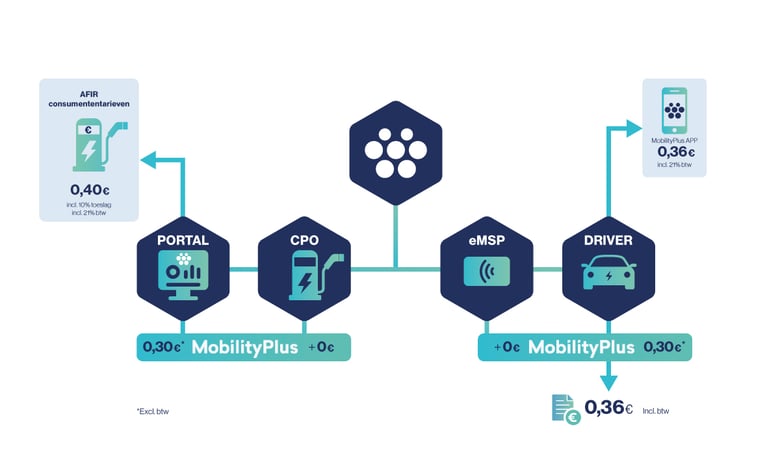
You charge with your MobilityPlus charge card at a charge point operated by MobilityPlus
Here, MobilityPlus is both the charge point operator (CPO) and your charge card provider (eMSP). Everything stays in-house: no roaming hub is needed, and MobilityPlus adds no service fees on top of the price set by the owner.
So you pay exactly the owner’s price: €0.30 + 21% VAT = €0.36 per kWh. That’s also the price you see in the MobilityPlus app.
Situation 2: debit card or QR code at a MobilityPlus charge point
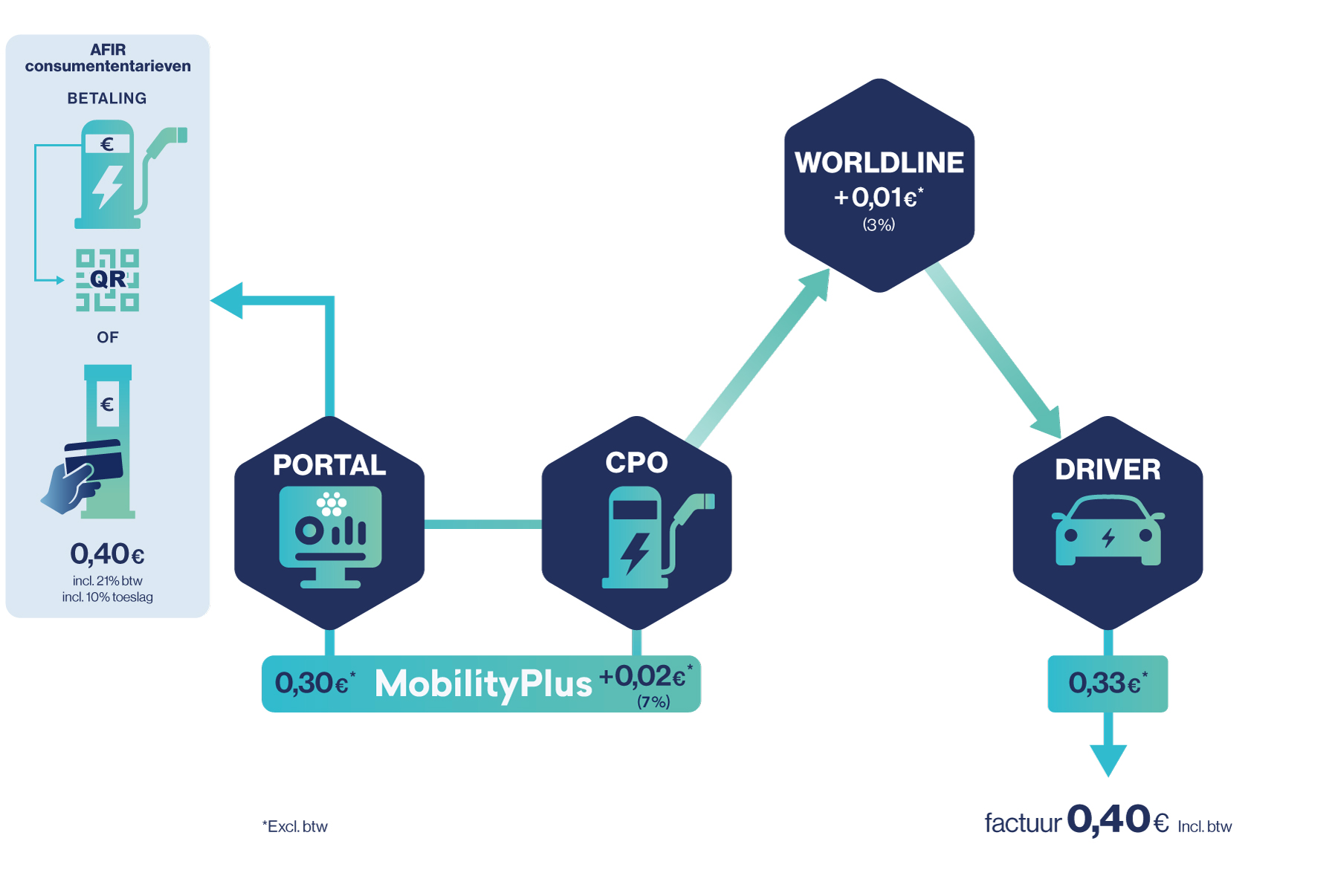
You pay by debit card or QR code at a MobilityPlus charge point
No charge card? You can pay by debit card, credit card or the QR code on the charge point. European rules (AFIR, the Alternative Fuels Infrastructure Regulation) make sure you can, and that the price for this payment method is clearly displayed on the charge point.
This price includes a 10% surcharge. Among other things, it covers:
- the fee the bank charges for every card payment (around 3%);
- the payment guarantee: the charge point owner always gets paid on time, even if a payment fails;
- the systems that display the price on the charge point and enable card payments;
- the helpline you can call 24/7 if something goes wrong. The number is on the charge point.
You pay: €0.30 + 10% surcharge + 21% VAT = €0.40 per kWh
Situation 3: MobilityPlus charge card at a charge point run by another operator
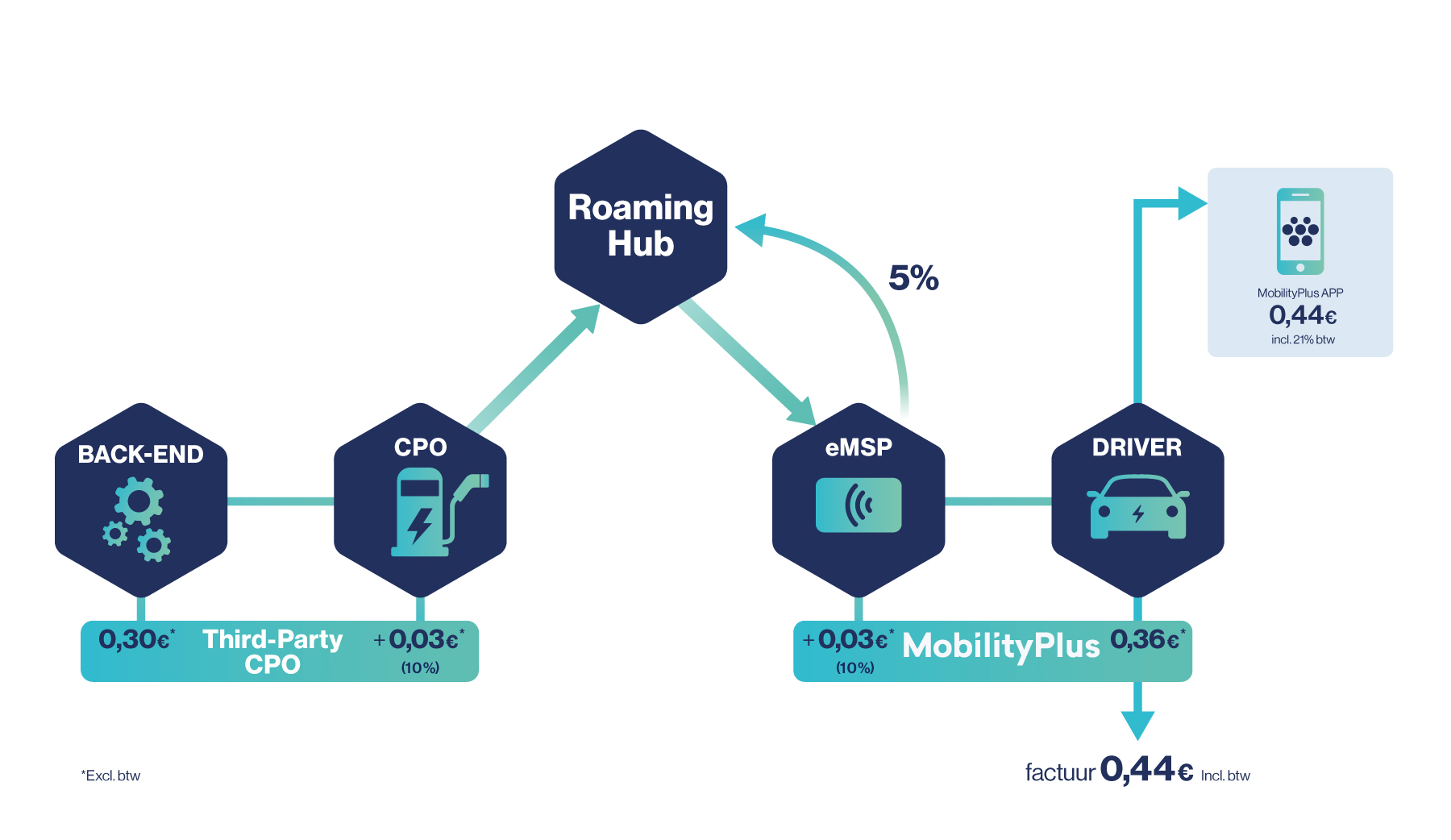
You charge with your MobilityPlus charge card at a charge point run by another operator
Here, the charge point operator (CPO) and your charge card provider (eMSP) are two different companies. To settle up with each other, they use a roaming hub, just as banks use a shared network so their customers can withdraw cash from each other’s machines.
In this example, both parties charge 10% in service fees:
- The operator adds 10% to the owner’s price: €0.30 becomes €0.33. Among other things, the CPO uses this to pay the roaming hub, which takes around 5%.
- MobilityPlus adds its own 10% service fee. Among other things, MobilityPlus uses this to pay the roaming hub, which takes around 5%. That brings the total to €0.36.
- With 21% VAT, you pay €0.44 per kWh. You’ll see this price in the MobilityPlus app before you start
The service fees an operator charges vary from one charge point to another. The 10% in this example is an average.
Situation 4: another provider’s charge card at a MobilityPlus charge point
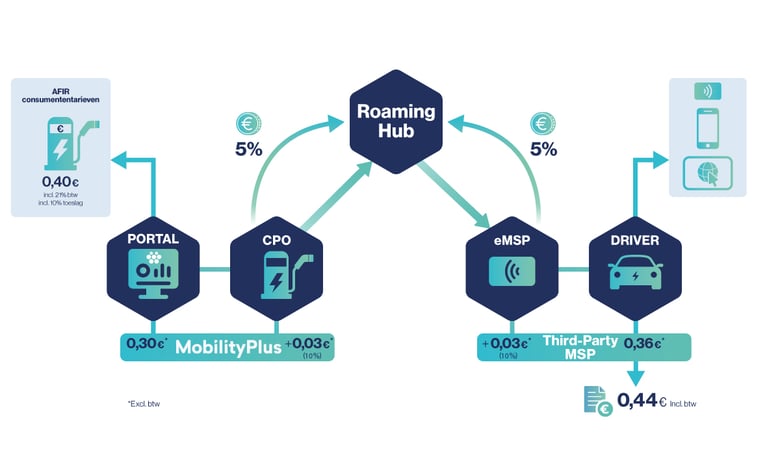
You charge with another provider’s charge card at a MobilityPlus charge point
This is situation 3 in reverse. MobilityPlus operates the charge point (CPO) and charges your charge card provider (eMSP) a 10% service fee: €0.30 becomes €0.33. Your charge card provider then adds its own service fees, also 10% in this example. That comes to €0.36 excluding VAT, or around €0.44 per kWh including VAT.
Both the CPO and the eMSP pay 5% to the roaming hub.
What you end up paying depends on your own charge card provider. You’ll only find the exact price in their app or on their website.
Why is the price on the charge point different from the price in my app?
Because the price on the charge point is the price for paying by debit card, credit card or QR code. If you charge with a charge card, you pay your charge card provider’s price. That can be lower or higher than the price on the charge point.
In short: the charge point shows the card payment price, your app shows the charge card price. To find out what you’ll pay with your charge card, always check your provider’s app or website.
How to keep your charging costs under control
- Check the price before you start. Open your charge card provider’s app and look up the charge point. Under European rules (AFIR), your provider must show you the price before you start.
- Choose your charge card carefully. If you often charge at one operator’s charge points, a charge card from that same operator is usually the best value, as there are no roaming costs. At a MobilityPlus charge point, the MobilityPlus charge card is the cheapest option.
- Compare charge cards on more than the price per kWh. Also look out for a monthly subscription, a fixed fee per session or a percentage on top of the price. Which option is cheapest depends on how often and how much you charge.
- Move your car once it’s full. Many charge points charge an idle fee as soon as your battery is full. Turn on notifications in your app or your car so you know when charging is done.
- Watch out for start fees on short sessions. A fixed amount per session weighs heavily if you only charge a few kWh. One longer session then works out cheaper than several short ones.
- Fast charging costs more. Fast chargers (DC, direct current) are handy on the road, but cost more per kWh than standard charge points (AC, alternating current). Use them when they save you time, not out of habit.
- Charge at home or at work whenever you can. That’s usually where you pay the least, because fewer intermediaries are involved, or none at all.
- Driving a company car? Check which charge card your employer provides and which costs they reimburse. That way you know where it’s best to charge.
- Check your invoice. For each session, your invoice shows where you charged, how many kWh, for how long and what it cost. That makes any discrepancy easy to spot.
Frequently asked questions
Why doesn’t the same charge point cost the same for everyone? Because the owner sets the base price, but every payment method and every charge card provider adds its own costs. So you pay the charge point price plus the service fees of the parties involved in your session.
What is roaming in electric vehicle charging? Charging with your charge card at a charge point run by an operator other than your charge card provider. It’s made possible by a roaming hub that connects both parties. It’s convenient, because one charge card lets you charge in a huge number of places, but it does cost a little extra.
What’s the difference between a CPO and an eMSP? The CPO (Charge Point Operator) runs the charge point. The eMSP (e-Mobility Service Provider) gives you the charge card or app and sends you the invoice. Sometimes they’re the same company, sometimes not.
What is an idle fee? A per-minute charge you pay when your car stays plugged into the charge point after it’s already full. It encourages drivers to free up the charge point for others.
Is paying by debit card more expensive than using a charge card? Not always, but often. At a MobilityPlus charge point, you pay €0.40 per kWh by debit card and €0.36 per kWh with the MobilityPlus charge card (in our example). With another provider’s charge card, it can even work out more expensive than paying by debit card.
Where can I find the exact price I’ll pay? Paying by debit card or QR code: on the charge point. Paying with a charge card: in your charge card provider’s app or on their website.
In summary
- The charge point owner sets the base price. The operator, charge card provider and roaming hub add service fees on top.
- Charging with a MobilityPlus charge card at a MobilityPlus charge point is the cheapest option: you pay the owner’s price, with no extra service fees.
- The price on the charge point is the price for paying by debit card or QR code.
- If you charge with a charge card, you’ll find the exact price in the app of your charge card provider. Always take a quick look before you start.
Quick glossary
|
Abbreviation or term |
What it means in plain English |
|
AC (Alternating Current) |
Alternating current. Standard charging at home, at work or on the street. |
|
AFIR (Alternative Fuels Infrastructure Regulation) |
European rules that, among other things, ensure you can also pay by debit card at public charge points and that prices are clearly displayed. |
|
CPO (Charge Point Operator) |
The company that operates the charge point. |
|
DC (Direct Current) |
Direct current. Fast charging, mostly on the road. |
|
eMSP of MSP (e-Mobility Service Provider) |
Your charge card provider: gives you the charge card or app and sends you the invoice. |
|
Idle fee |
Per-minute charge when your car is full but stays plugged into the charge point. |
|
kWh (kilowatt hour) |
The amount of energy that goes into your battery, like litres when you fill up with fuel. |
|
Roaming hub |
The network that lets your charge card work at charge points run by other operators. |