Does Your Fleet TCO Model Tell the Full Story?
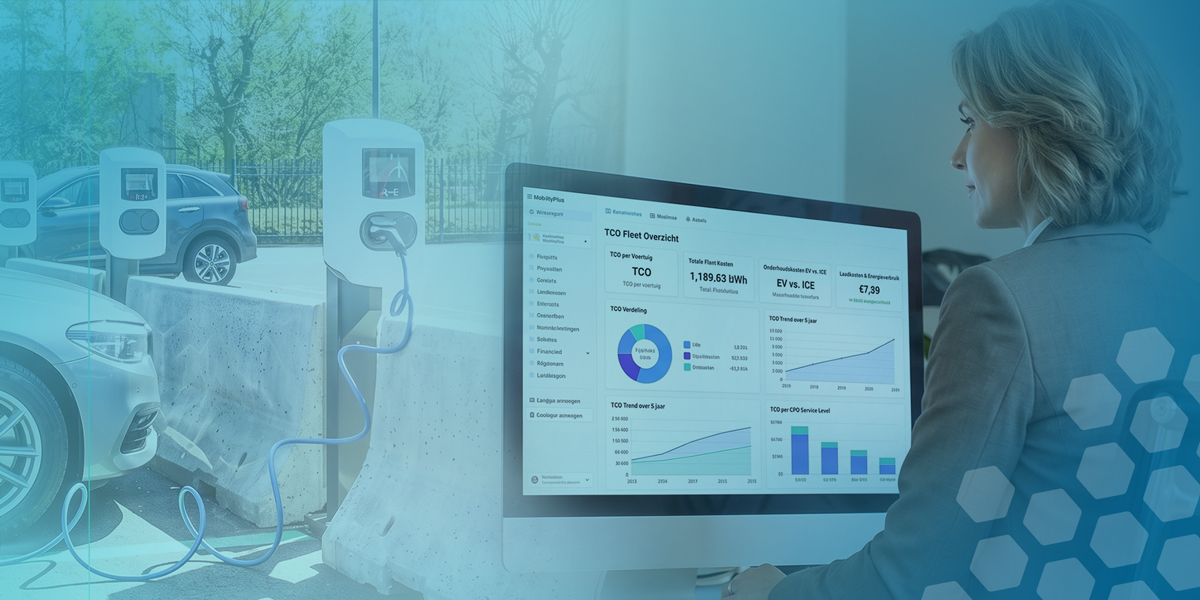
The TCO model is in order. The business case for electrification has been approved. And then the first invoices arrive.
For many fleet managers, this is the current reality. The transition to electric driving has been strategically planned, the numbers stack up and management has signed off. But as charging infrastructure costs, charging card fees and public charging bills begin to accumulate, confidence in those numbers starts to erode. The gap between the modelled cost and the actual cost is not a calculation error — it is a structural limitation of TCO itself.
TCO Was Designed for a Simpler World
Total Cost of Ownership remains a relevant metric. It informs vehicle selection, depreciation planning and fleet composition decisions. But TCO is built on assumptions: average charging behaviour, standard energy prices and the premise that most drivers charge at home under controlled conditions.
None of those assumptions holds universally. Not every employee has access to a home charging station. Some drivers rely primarily on public charging infrastructure or fast chargers. Others split their charging between home, the workplace and the road. The result is that the actual cost of charging can vary significantly from one driver to the next — sometimes by multiples.
Total Cost of Use: The Metric That Reflects Reality
This is why a complementary KPI is gaining ground among leading fleet operators: Total Cost of Use (TCU).
Where TCO models the expected cost, TCU measures the actual cost of electric driving — broken down by employee, by charging session and by location (home, workplace, public network). It replaces theoretical averages with a real-time picture of what your fleet is actually costing.
The operational value is immediate. With TCU data, fleet managers can identify which drivers consistently charge via expensive public or fast-charging infrastructure, pinpoint locations where charging infrastructure is absent or underused, and quantify the precise cost impact of different charging behaviours across the fleet.
Why Timing and Location Now Determine Your Cost Base
Rising energy prices and the growing application of capacity-based grid tariffs have made electric charging an energy management issue, not merely a mobility one. When charging occurs is now as consequential as where it occurs. Unmanaged charging — vehicles drawing power during peak demand periods — can substantially increase a site’s grid costs, independently of the total volume of energy consumed.
Without visibility into TCU and without active energy management, cost overruns are not a risk. They are a certainty.
From Insight to Operational Control
MobilityPlus provides a complete charging infrastructure and management solution, built around the operational reality of mixed-fleet environments.
Through the MobilityPlus platform and integrated Energy Manager, organisations gain full visibility into charging behaviour and costs across both TCO and TCU dimensions. The system automatically optimises vehicle charging schedules to avoid peak demand periods, reduces exposure to high grid tariffs and supports active steering towards lower-carbon energy sources.
For drivers, the solution eliminates friction: access to a reliable charging network, a straightforward home charging setup and a charging card accepted at over 850,000 charging points across the EU — without the need to manage multiple accounts or separate reimbursement processes.
Control, Transparency, and the End of Charging Surprises
For fleet managers, the practical outcome is consolidated data, predictable costs and a clear reporting framework that removes the need for manual reconciliation or disputed reimbursements.
Electrification is not only a question of which vehicles you operate. It is a question of how you manage energy, behaviour and infrastructure together. Organisations that focus solely on TCO are working from an incomplete picture of their charging costs.
The question is not whether to adopt TCU as part of your fleet management framework — it is how quickly you can implement it and what cost savings you will recover in the process. To understand what electric charging is actually costing your organisation today, and to explore the tools and strategies that can bring that cost under control, speak with MobilityPlus.