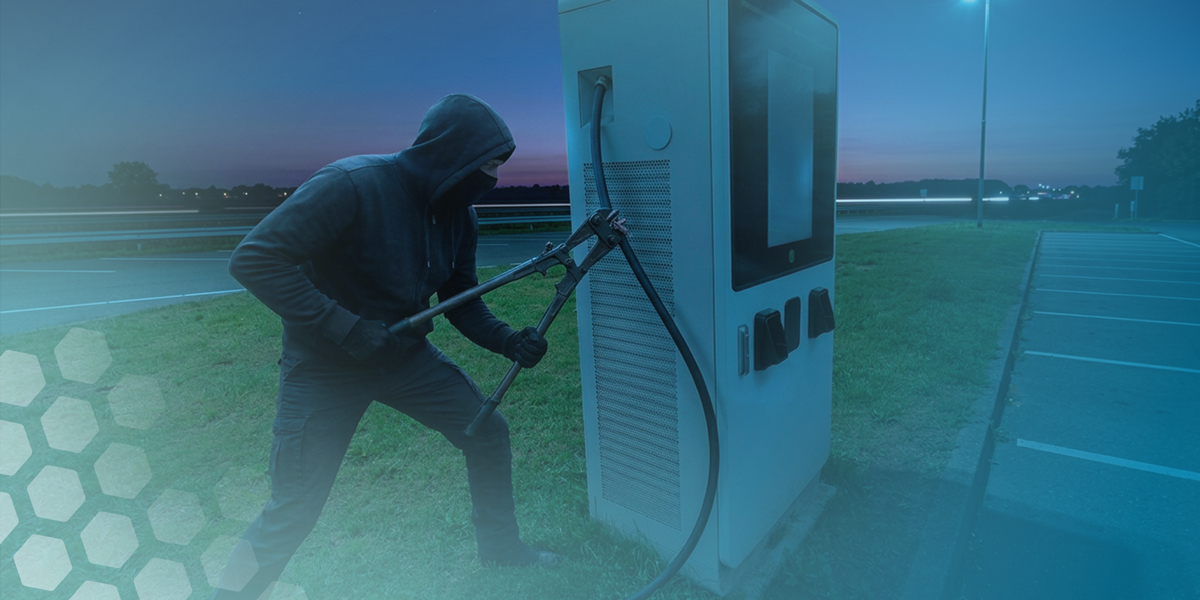
In short: Copper thieves increasingly target public (fast) charging stations for the copper in the cables, in late May 2026, 8 fast chargers in Ypres were put out of service, following earlier cases in Lanaken, Maasmechelen, Tongeren and Herent. For operators this means costly repairs, days or weeks of downtime and reputational damage; for drivers, an unavailable charge point. You protect your charging infrastructure with a combination of visible locations, physical security, smart technology, real-time monitoring and fast repair.
MobilityPlus takes it fully off your hands: from advice and monitoring to a fast repair service and support with reporting.
What you'll find in this blog
- What is cable theft at charging stations?
- Why are charging cables a target?
- What is the impact of cable theft?
- How do we map cable theft together?
- How do you protect charging stations against cable theft?
- Frequently asked questions about cable theft at charging stations
What is cable theft at charging stations?
The rise of electric driving brings not only benefits but also new challenges. One of them has surfaced more and more in recent months: the theft of charging cables at public charging stations. What first seemed sporadic is growing into a real problem affecting both drivers and operators of charging infrastructure.
The most recent example is telling: in late May 2026, eight fast-charging stations near the Rijselsepoort shopping centre in Ypres were put out of service after thieves cut and stole the charging cables. But Ypres is not alone. Earlier this year, charging cables were also cut in Lanaken, Maasmechelen, Tongeren, Herent and several other locations.
Why are charging cables a target?
The answer is simple: copper. Charging cables contain a significant amount of copper, a metal with a high market value. For thieves, a stolen cable quickly yields a few dozen to a hundred euros. The loot is often sold on the black market abroad.The method is always the same: the fixed charging cable is cut, the copper is extracted and the perpetrators disappear extremely quickly. With the right equipment, a cable is gone in seconds. The sector suspects that part of the thefts is the work of organised, international gangs. This wave previously hit neighbouring countries such as Germany and France, and is now reaching Belgium.
What is the impact of cable theft?
The damage goes far beyond the cost of a cable:
- For operators (CPOs and businesses): material damage, costly repairs and, often most painful, charge points out of service for days or weeks. That means lost revenue and reputational damage.
- For drivers: a charging station that is unavailable exactly when you need it. The frustration of a display reading "Cable theft detected. Charge point unavailable."
- For the energy transition: every charge point out of service undermines trust in a reliable, future-proof charging network. And that trust is exactly what's crucial to convince people to drive electric.
How do we map cable theft together?
For a long time there was no central overview: incidents were reported locally or stayed under the radar. As a result, the true scale of the problem was hard to estimate.
That is now changing. Sector federation EV Belgium has launched a reporting point where both recent and historical incidents can be registered. That's an important step: the more data, the better we recognise patterns, geographic hotspots, the times when thieves are active and links with certain types of charge points. With those insights, operators, cities and police services can act preventively and in a targeted way.
📍Reporting helps. Was your charging station the victim of cable theft, or an attempt? Register the incident via EV Belgium's reporting point. Every report helps the sector understand and tackle the phenomenon.
How do you protect charging stations against cable theft?
There is no silver bullet, but a combination of measures significantly raises the barrier for thieves. The principle is always the same: the harder and slower you make the theft, the more time a thief needs and the greater the chance of getting caught. That's exactly why many opportunistic thieves give up.
- Location and visibility: place charging stations in well-lit, visible spots, ideally under camera surveillance.
- Physical security: lockable cables, protective covers and robust housings make cutting harder.
- Technological solutions: think of cables with a built-in dye or marking system (like a dye pack), alarms or even cables with integrated tracking.
- Monitoring: real-time monitoring of the status of your charge points ensures you detect an incident immediately, not days later.
- Fast repair: a smooth service and repair chain keeps downtime to a minimum.
How does MobilityPlus ensure complete peace of mind?
For operators and businesses, cable theft is yet another worry on top of an already complex story. At MobilityPlus, we believe you should be able to focus on your business, not on your charging infrastructure. That's why we ensure complete peace of mind:
- Advice on the right hardware and security, tailored to the risks of your location;
- Monitoring of your charge points, so a problem (theft, defect or malfunction) is immediately visible;
- A smooth service and repair service that keeps downtime to a minimum;
- Guidance with reporting and follow-up if something happens anyway.
Cable theft is a sector-wide problem that we can only solve together: by sharing information, securing smartly and taking responsibility as a sector. MobilityPlus is happy to take up that challenge, alongside our partners and customers.